|
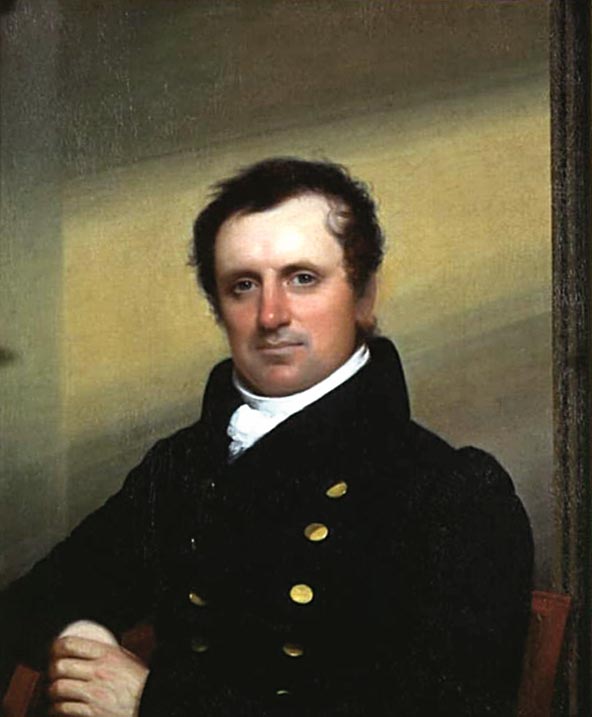
James Fenimore Cooper was born in Burlington, New Jersey, in the family of a rich landowner.
This place now called Cooperstown, was a frontier town; beyond it was wooded wilderness. The future author grew up in Cooperstown where he saw the varied life on the border of wilderness. He heard many tales of adventures and learned to feel the mystery of the dark forest.
He studied at Yale for three years but most of his education he got from out-door life. When James was ten years old. he could ride on horseback, fish, swim, shoot with bow and arrow and skate. In 1806 he joined the navy and for a year he served on a merchant ship as an ordinary sailor and then he was a midshipman in the United States Navy. In 1810 James Cooper married and settled down to a life of a farmer and a country gentleman.
Cooper began writing at the age of thirty. In 1820 he produced his first novel Precaution. This novel on English manners was a failure but it succeeded in arousing persistence in the young writer. In 1821 he published his second book The Spy which dealt with events of the War of Independence. The book was an immediate success in England and America. Its success made him write another book The Prisoners, and later The Last of the Mohicans. He wrote six novels for five years, and they established his reputation as a writer.
In 1826 Cooper went to Europe for a tour. He had spent seven years (1826-1834) traveling in England, Germany, Switzerland and Italy. He worked all the time. He wrote seven novels, a lot of articles, essays and letters.
Cooper left about 40 books belonging to various genres: 1) five romances of the American frontier The Leatherstocking Tales; 2) sea tales, the most famous among which are The Pilot (1823), Red Rover (1827), and The Two Admirals (1842); 3) historical novels, such as Lionel Lincoln (1825), The Bravo (1831), The Heidenmauer (1832) and The Headsman (1833); 4) a social satire The Monikins (1836).
According to their merits Cooper’s works are very uinequal and his views on various subjects are contradictory. In his historical novels on Europe Cooper showed the superiority of American democracy. Later, when he returned from the trip to Europe, he was disappointed in American life. In his novels Homeward Bound (1838), Home As Found (1838) and his essays A Letter to his Countrymen (1834) and The American Democrat (1838) Cooper criticized the ruling class, its lack of culture and the corruption of the press.
James Fenimore Cooper died at Cooperstown on September 14, 1851.
| 10.2. The Leatherstocking Tales |
|
Cooper’s fame as a novelist rests on his five novels of the American frontier, called The Leatherstocking Tales. To follow the sequence of events we should read them in the order given below: The Deerslayer (1841), The Last of the Mohicans (1826), The Pathfinder (1840), The Pioneers (1823) and The Prairie (1827). The name of the hero is Natty Bumppo.
The author describes the America of the 18th century when it was still being explored and colonized by Europeans who settled there and drove the Indians from their land.
The Deerslayer shows Bumppo’s youth as a hunter brought up among the Delaware Indians. He is a perfect woodsman. The Delaware Indians are his best friends. They have taught him to read the signs of the virgin forest, to follow trail, to become a good marksman.
Every leaf or twig tells him a whole story of people and wild animals passing through the wood. Cooper stresses that Bumppo’s nobility of spirit, his self-reliance, justice and fidelity have been developed by the life he has led in the forest and his closeness to the Indians. The writer emphasizes that the white people, intruding on the Indian hunting-grounds, provoke wars and bring corruption to the noble and simple Indians.
In The Pioneers Natty Bumppo comes into an open conflict with the bourgeois law which defends property. He is punished for hunting a deer out of season.
In The Prairie, Natty, now an old man, leaves his forests, being driven out by the advance of civilization, and lives as a trapper on the Western Plains. The sound of the axe drives him further and further to the West. He dies conquered by the civilization he hates.
Cooper was a good storyteller. His descriptions of nature, exciting incidents, pursuits, last-minute rescues keep the reader in suspense. His fame rests on the variety of dramatic incident and vivid depiction of romantic backgrounds.
The portraits of the Indians depend on whether they support the English or their enemies, the French. The supporters of the English are noble whereas those of the French are cunning.
Yet, the customs of the Indian tribes and their struggle against the invaders have been described in detail and true to historical facts.
Cooper’s main merit lies in the fact that he managed to convince the readers of the human worth of the Indians. The character of Natty Bumppo will remain in the reader’s memory as one of the most remarkable fictional heroes in world literature.
| 10.3. Edgar Poe (1809-1849) |
|

Edgar Allan Poe, outstanding romantic poet and short-story writer, was one of the first professional writers of the United States. But in his lifetime he was more popular in Europe than at home.
Edgar Poe was born in Boston in 1809. The son of actor parents, he was left an orphan at the age of three. And though he was taken under protection of a prosperous tobacco merchant John Allan, his childhood was miserable. Mr Allan’s business took him abroad, and from 1815 to 1820 Poe lived with the family in Scotland and England. He attended a fine classical preparatory school. There he wrote Latin verses and learned boxing. Back in the United States, he was sent to the University of Virginia. These studies he combined with writing poetry, and all the while he read and read and read. Yet Poe was unhappy at the university. His sensitive pride was wounded by the social barrier between him and the rich Southern boys. At the end of the first year Mr Allan decided to remove him from the university. The tobacco merchant had never understood the boy’s vocation for art. He made him a clerk in his business. Poe immediately ran away and went to Boston. In Boston he published his first volume of poetry Tamerlane and Other Poems (1827). Not a single copy was sold. Then he published in Baltimore his second volume of poems Al Aaraaf, Tamerlane and Minor Poems (1829). His poems again passed unnoticed. In 1831 Poe published his third edition of poems, this time in New York. However, Poe first became famous not as a poet, but as a writer of fiction, with a story he wrote for a magazine. It was the story MS Found in a Bottle. It was printed in the Baltimore Saturday Visitor and won him a prize of 50 dollars. In 1835 he got a position in the Southern Literary Messenger. He published his old and new tales and poems in this magazine. He wrote many book reviews which won popularity for the magazine. After Poe had married a very young girl Virginia Clemm, the daughter of his father’s sister, Maria, he spent the rest of his life in Philadelphia and New York. Soon his young wife became very ill with tuberculosis. In 1847 his wife died, and in October 1849 Edgar Allan Poe’s life ended. During his lifetime only a few of his stories and poems won fame.
Edgar Poe distinguished himself in three fields: in the short story, poetry and criticism. He wrote about 60 stories and 48 poems. The writer is a great master of the short story. His prose is direct, energetic, clear and aimed to focus the reader’s attention on one particular idea. His aim in every work, he said, was to make a strong impression on the reader. Poe’s stories may be divided into horror stories and detective stories.
The most distinguished horror stories are: The Fall of the House of Usher, The Black Cat, The Descent into Maelstrom. The horror stories concentrate on various forms of suffering. They represent a psychological study of anxiety and terror, of passion, anger, revenge and other emotions suffered by men who think they are destined for some strange fate. All Poe’s best stories show some triumph of mind over the danger to which the hero seems doomed.
The detective stories are mathematical at their foundation. Having invented a combination of events and circumstances the author logically follows step by step their development and the consequence comes with the precision of the solution of a mathematical problem.
Poe if the father of the detective story in America. He created the first of a long line of fictional master detectives Auguste Dupin. Dupin is a very attractive character in Allan Poe’s stories. The reader delights in his common sense, wit and optimism. The author endows him with extraordinary powers of deduction and analysis. Dupin is the forerunner of Conan Doyle’s Sherlock Holmes.
Poe’s best known detective stories are: The Murder in Rue Morgue and The Mystery of Marie Roget.
Poe is a poet of beauty. His constant themes are the death of a beautiful woman and the grief caused by it. Poe’s best poems are: The Raven, The Bells, Annabel Lee, and some of the lyrics and sonnets.
The European poets appreciated the harmony between idea and form achieved by Edgar Allan Poe. The Russian composer Rakhmaninov was so impressed by The Bells that he set it to music; and the poet Valery Bryusov translated many of his poems and called Poe the greatest poet of the United States.
Edgar Allan Poe is remembered as the writer who established a new kind of poetry and the new short story based on psychological analysis.
| 10.4. Henry Longfellow (1807-1882) |
|

Henry Wadsworth Longfellow was born in the little town of Portland, in the State of Maine on the Atlantic coast in the family of a well-to-do lawyer.
The family kept alive the memory of the War of Independence, and as a boy Longfellow was told about the heroic deeds of his grandfather who had been a general in Washington’s army, and about his uncle Henry who had been an officer in the US Navy and had been killed in 1804 while defending his country. The family traditions of heroism played a great role in the life of young Longfellow.
Prepared mostly at private schools, he attended Bowdoin College from 1821 to 1825, and there he wrote his first verses and stories and showed great aptitude for foreign languages. Having published his first poem at thirteen he dreamed of a literary career. On his graduation, he was made professor of Modern Languages at Bowdoin. He spent three years in France, Spain, Italy and Germany, studying European languages and literature.
In 1829 Longfellow returned home and began teaching foreign languages, first at Bowdoin College and then, in 1834, as a professor of Harvard University.
In 1835 Longfellow published his first book Outre-Mer: A Pilgrimage Beyond the Sea, a series of travel-sketches modeled on Washington Irving’s Sketch Book. In 1835 he made a second trip to Europe, visiting Germany, Sweden, Denmark and Holland, where he studied German and Northern literatures to qualify himself for his appointment at Harvard. In 1839 he published his novel Hyperion and a collection of poems Voices of the Night. In 1841 a new book of poems Ballads and Other Poems saw print. By that time he was well-known as an American poet, and his fame steadily spread.
After his third trip to Europe Longfellow published his masterpiece, a collection of verses Poems on Slavery (1842). Slavery had become the most urgent question of the day. In these verses Longfellow condemned the shameful institution of slavery. In his political verses he gives the sad and shameful picture of slavery in the South of America.
In the poem The Slave’s Dream a black slave, on a hot summer noon on a Southern plantation, weary from his heavy work, falls asleep in the sun, his hand grasping the reaping hook. He dreams he is back in his native Africa. He sees his wife and children. Suddenly this vision is rudely and cruelly interrupted by two severe blows of a long whip. The raging overseer whips the slave to death.
In another poem, The Negro in the Dismal Swamp, the author describes a typically American scene of those days – the hunting down of a slave.
The Poems on Slavery were published eighteem years before the Civil War broke in 1861. Longfellow foretold coming of a war that would free the Negro slaves at a time when nobody believed it could be possible.
Another poem which was finished in 1847 was Evangeline. It was the story of how the Acadian farmers were driven away from their village. It was the most beautiful poem Longfellow had written so far.
Longfellow’s philosophical lyrics were a great success in the 50s and 60s during the Civil War. Especially popular was his poem The Building of the Ship. The people in Longfellow’s poem are represented by a tireless master worker who spares no effort to build a beautiful ship – a democratic state, a republic, where the freedom and equality of the citizens is the supreme law. In this poem Longfellow clearly expresses his social ideals.
In his mature years Longfellow created beautiful lyrics about nature. American nature came to life under Longfellow’s pen. Before him the descriptions of nature by poets, though very beautiful, were abstract. He was especially skilful in depicting the seasons of the year.
Henry Wadsworth Longfellow was a great friend of the Indians. Even as a student he began to collect Indian folklore. But it was some 30 years after he had graduated from the university that he was able to finally complete his epic poem The Song of Hiawatha – the only epic poem in American literature in which the manner of life and the beliefs of the Indian people are described. The Song of Hiawatha appeared in 1855. It made the name of Longfellow famous all over the world.
Henry Longfellow knew twelve foreign languages, as well as ancient Greek, Latin, Gothic, Hebrew, old French and old German. He compiled and translated a vast anthology called Poets of Europe. This colossal work of translating poets of different times and different peoples was finished by the end of the 70s when the last of the 31 volumes saw print. Up to the present day this anthology remains one of the best of this kind. Besides this collection of European lyrical poetry Longfellow translated in 1865-1867 Dante’s Divine Comedy.
By the end of his life Longfellow had won recognition all over the world. Many universities awarded him with honorary degrees, so did St Petersburg Academy of Sciences of which he became a member. He was also elected to membership by the Spanish, British and French Academies of Sciences. Even when already an old man, Henry Longfellow continued writing. Longfellow died at the age of 75. He is the only American poet whose bust is in Westminster Abbey’s Poets’ Corner.
| 10.5. The Song of Hiawatha |
|
America has no ancient folk-songs similar to the great epic of other nations. Longfellow made a study of European poetry and chose the Finnish epic poem Kalevada as his model for the epic poem he was to write. The second source of his poem was Indian folklore. Already at college he had read much about the Indian nation, their history, manners and customs, on the basis of which he wrote his epic poem The Song of Hiawatha.
The poem relates of the Indian warrior hero, Hiawatha, partly a legendary, partly a historic personality. According to a North American Indian legend, the hero was sent by the Great Spirit Manito to unite the various Indian tribes.
Hiawatha was born of the daughter of a Star Wenonah and the West Wind, Mudjekeewis. After his mother’s death, the boy grows up in the wigwam of Nakomis, his grandmother, the daughter of the Moon. The young Hiawatha learns all the arts and the skills of the Indians and comes to know all the secrets of nature. He learns the language of the birds and animals and calls them “Hiawatha’s brothers”. He grows into the youth of unusual strength, swiftness and cleverness.
When Hiawatha learns how his father deserted his mother, he decides to punish him. In the land of the West Wind, he and Mudjekeewis fight for three days. Being a god, Mudjekeewis is immortal. However, he acknowledges Hiawatha’s courage and nobility and sends him to the earth to fight evil, to do deeds of valour and unite the Indian peoples. On his way Hiawatha stops in the land of Dakotahs and meets a lovely girl, the daughter of the arrow-maker, Minnehaha, and takes her home as his bride.
Among Hiawatha’s heroic deeds is the defeat of Mondamin, the Corn Spirit, whose death teaches Hiawatha and his people how to grow maize. Together with his good friends, Chibiabos, “the best of all musicians and the sweetest of all singers”, and Kwasind, “the strongest of all mortals”, Hiawatha kills Pearl-Feather, who brings death and diseases on the Indians, clears the rivers and streams, so that his people can sail on them in safety, teaches them to follow trail, collect herbs and use medicine. “Buried is the war-club”, peace rules among the Indian tribes, and happy days follow in the Ojibway land. Hiawatha and Minnehaha have a gay wedding party at which the guests relate stories and legends, and the reader learns of many interesting Indian customs.
Then evil times come to the Indians. Chibiabos perishes, breaking through the ice into a lake. Strong Kwasind, too, is killed by the evil dwarfs who conquer him using the cone of the blue fir-tree. With winter, the famine and fever come. Hungry are the women and the children.
Minnehaha dies of starvation. Hiawatha sails to rule over the land of the Northwest wind.
At a time, when the Indians were considered a lower race, Longfellow managed to show the beauty of their character, their valour, their closeness to nature, the charm of their customs and legends.
The Song of Hiawatha was translated into many European languages. The Russia translation was made by I. A. Bunin. The originality and novelty of its literary form, the unknown poetic world of Indian folklore surprised everyone and attracted world attention.
Полный текст лекции: https://bspu.by/moodle/mod/lesson/view.php?id=126763&pageid=33503
ДОМАШНЕЕ ЗАДАНИЕ:
Questions on the topic 10 “American Romanticism”
- What was the first book by Fenimore Cooper that brought his immediate success in England and America?
- In what different genres did Fenimore Cooper work?
- Name the order in which The Leatherstocking Tales should be read.
- What is the name of the protagonist of The Leatherstocking Tales?
- What is the main merit of Fenimore Cooper?
- Where was Edgar Allan Poe the most popular?
- What was the first literary work by E. A. Poe?
- What three genres did E. A. Poe write in?
- What was the main thing that E. A. Poe brought to the world of literature?
- Who inspired Henry Longfellow for his first book?
- Name the work by Henry Longfellow which was devoted to slavery.
- What was the main topic of Longfellow’s poetry when he was in his mature age?
- What were Longfellow’s merits in the sphere of science and education?
- What was The Song of Hiawatha dedicated to?
- Who made the Russian translation of The Song of Hiawatha?
- What made The Song of Hiawatha so popular in the whole world?
|
|
|
|
|

 RSS
RSS


